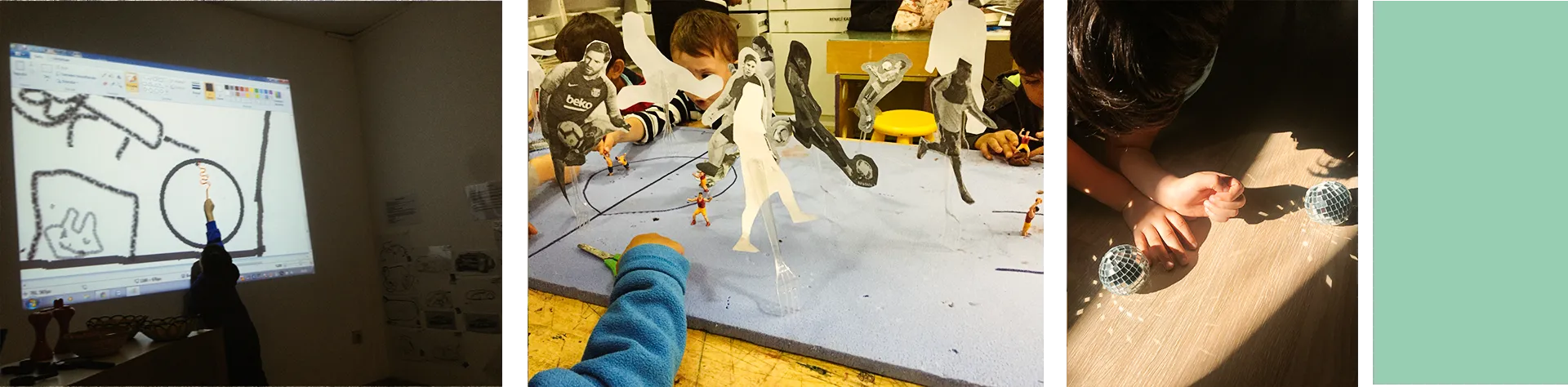
In the Reggio Emilia Approach, the entire physical environment—where children explore their curiosities, engage their senses, and concretize their learning—is conceptualized as the "Environment as the third teacher."
For children it's "play"; for adults it's a "project."
Although we use the term "Projects," we prefer to focus on the authentic "learning experiences" shaped by children's curiosity, without weighing them down with overly academic terminology. At Meşepalamudu, we do not follow a rigid, pre-packaged curriculum. Instead, we carefully observe the children's emerging curiosities and interests, and then we nurture that process by creating environments designed to deepen those inquiries. Sometimes a single curiosity captivates the entire class; other times, distinct interests sprout within smaller groups of 3 to 5 children. Intrinsic curiosity is a far more powerful motivator than any adult-imposed curriculum or highly structured activity. Furthermore, we believe that "Learning what you are genuinely curious about is a fundamental right of the child."
In the Reggio Emilia Approach, the project process is often likened to a bowl of spaghetti.
It is not a straight line, but rather an unbroken, tangled, winding path that loops forward and backward. Along this path, both the social and physical environments are meticulously structured to allow children to operate at the peak of their potential development. Customized spaces are designed to help them cultivate their unique modes of expression, which we refer to as the "languages of the child." During a project, tools like light tables, overhead projectors, and other reflective devices are set up as technical discovery corners. While there is no strict curriculum, there are always detailed, thoughtful plans on how to effectively chase the children's curiosity. The most critical elements of a project are ensuring that the process remains entirely child-led, that learning occurs organically through peer collaboration, that children actively engage their senses to make their experiences tangible, that they are encouraged to form hypotheses, and—most importantly—that all of this profound learning happens naturally within the context of children's play.